Define the decision latency and failure tolerance first
Remote infrastructure devices live longer than phone applications and often sit where access is costly. Architecture therefore has to tolerate intermittent networks, constrained power, firmware changes and component replacement. Keep acquisition, validation, storage, communications and operational decision logic separable. A modular design makes it possible to replace one layer without losing the meaning of the data or rebuilding the entire service.
Start by writing the operational question in one sentence: Which functions must keep working locally when power, backhaul or the cloud is unavailable? Then define who will act, how quickly they must act, and what independent evidence will confirm that the action worked. A reading that cannot change a decision may still be useful for research, but it should not be confused with an operational alert. For remote IoT sensor architecture, the most common design error is to instrument the measurable variable before agreeing on the service decision it is meant to improve.
Turn architecture requirements into interface rules
Give every device a stable identity
Give every device a stable identity. Fleet operations, security and replacement records depend on knowing exactly which physical and logical device produced a record. Use unique identifiers and maintain the mapping when hardware is replaced. This makes the decision inspectable: another operator can see what condition triggered the choice, what evidence should be recorded, and what would cause the choice to be revisited.
Buffer before you transmit
Buffer before you transmit. The radio is not a database and remote networks are not continuous. Persist readings locally with timestamps and upload idempotently after reconnect. This makes the decision inspectable: another operator can see what condition triggered the choice, what evidence should be recorded, and what would cause the choice to be revisited.
Expose health as data
Expose health as data. Operators cannot distinguish a quiet asset from a dead device if voltage, reboot, storage and link state are hidden. Define a compact health payload and alert separately on telemetry failure. This makes the decision inspectable: another operator can see what condition triggered the choice, what evidence should be recorded, and what would cause the choice to be revisited.
Plan secure updates and configuration
Plan secure updates and configuration. Long-lived field devices need controlled change without making the network an uncontrolled administrative interface. Specify authorization, update verification, rollback/recovery and configuration history. This makes the decision inspectable: another operator can see what condition triggered the choice, what evidence should be recorded, and what would cause the choice to be revisited.
Document every interface in the data path
A field design is only reproducible when the variables behind it are visible. The table below is a minimum record for remote IoT sensor architecture. Do not replace unknowns with optimistic defaults. Mark them unknown, collect the missing observation during the pilot, and record the date and method used to resolve them.
Document the architecture at the interfaces: sensor output type and units, logger channel/range, sampling interval, local buffer capacity, time source, radio technology, backhaul path, cloud endpoint and export format. Most integration failures occur where one component assumes behavior that the next component does not actually provide.
| Variable | Record | Why it matters |
|---|---|---|
| Sample payload | bytes/sample | Drives storage and energy needs. |
| Sample interval | seconds/minutes | Sets signal resolution and local write volume. |
| Report interval | minutes/hours | Separates radio duty cycle from measurement frequency. |
| Buffer horizon | days | Defines resilience to network outages. |
| Update method | local/remote/hybrid | Determines service access and security process. |
| Identity scheme | logical + physical ID | Supports audit, swap and decommissioning. |
Troubleshoot from sensor edge to cloud
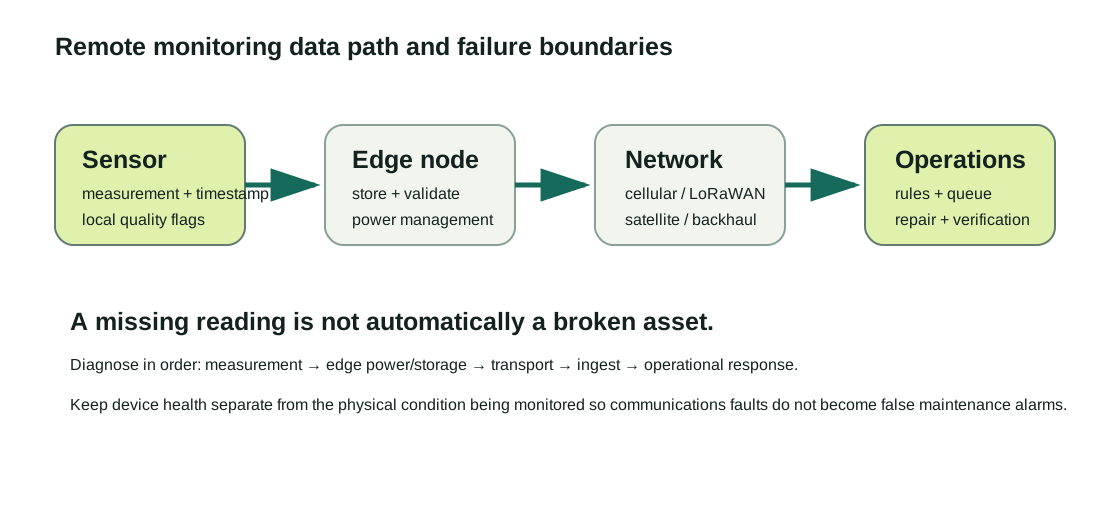
Remote monitoring collapses several failure domains into one screen. A flat line, a missing packet and a real infrastructure fault can look similar if the telemetry does not expose device health. For remote IoT sensor architecture, use the sequence below before assigning a repair crew. The purpose is not to delay urgent response; it is to prevent a communications or sensor fault from being mislabeled as an asset failure.
When data disappears, troubleshoot from the edge outward. Confirm sensor excitation/output, logger acquisition, local timestamps and storage before blaming the network; then check radio registration, gateway/backhaul and cloud ingestion. This sequence prevents a cloud outage from being confused with a dead sensor—or vice versa.
| Observed pattern | Likely checks | Next action |
|---|---|---|
| Values jump after device swap | calibration, mapping, units, firmware transforms | Check identity mapping and reference before treating as environmental change. |
| Duplicate records after reconnect | retry/idempotency key, sequence number | Deduplicate on stable record identity, not arrival time. |
| Battery drains faster at weak sites | retries, attach failures, radio signal | Measure retry behavior and optimize reporting/profile. |
| One firmware cohort goes silent | version, update status, rollback availability | Stop rollout and recover using documented update path. |
Commission each boundary in the architecture
Commission every boundary in the chain with evidence: raw sensor reading, logged record, buffered record, transmitted payload, received cloud value and exported record. Force one reboot and one temporary network loss so you know what duplicates, gaps and timestamps look like during recovery.
For remote IoT sensor architecture, complete the following steps in order. If a step fails, correct it before treating later successful steps as proof of readiness. A cloud dashboard receiving one packet is not enough if the sensor reference, timestamp, power behavior or alert route is still unverified.
- Assign physical and logical device identifiers and verify they appear in exported records.
- Disconnect network access and confirm acquisition/storage continues for the defined buffer horizon test.
- Restore network and verify old records upload with original timestamps and no duplicates.
- Change an authorized configuration value and verify the audit trail records old/new values.
- Attempt an unauthorized configuration path as permitted by the test plan and confirm it is rejected.
- Verify update authenticity/rollback behavior using the supplier’s supported test procedure.
Test recovery, time and data continuity before scale-up
Architecture acceptance should include normal data plus failure recovery. Verify buffer duration, clock behavior without network time, duplicate handling, message ordering, device restart, credential renewal and data export. A system that only works during uninterrupted connectivity has not demonstrated remote-operating resilience.
Choose sampling, buffering and retry policies from the decision latency and energy budget rather than a default template. Fast sampling with infrequent upload may be appropriate for event reconstruction; low-rate monitoring may need fewer samples but stronger health signals. Record the rationale because it affects storage, power and network cost.
- Identity — Every record maps unambiguously to an installed physical device.
- Offline operation — Measurement and local storage continue through the planned link-loss test.
- Recovery — Queued records arrive once, ordered by event time rather than connection time.
- Observability — Voltage, reboot and link/storage health are accessible to operators.
- Controlled change — Only authorized entities can change configuration/update software.
- Export — Raw values, timestamps and quality flags can be exported in documented form.
Worked example
Scenario. A node samples two 4-byte values plus a timestamp/flags record totaling 24 bytes every 5 minutes and must survive seven days without backhaul.
Calculation or rule. 12 samples/hour × 24 hours/day × 7 days × 24 bytes ≈ 48,384 bytes before filesystem/protocol overhead. Provision substantially more than the arithmetic minimum for metadata, retries and wear management.
Interpretation. Local storage capacity is usually cheap compared with a field visit, so size for uncertainty rather than the bare payload. The example is intentionally transparent so the inputs can be replaced with local values rather than copied as a universal recommendation.
What field systems reveal about resilient IoT architecture
NIST’s IoT capability baseline treats device identification, controlled configuration, data protection, interface access control and secure software updating as foundational device capabilities. GSMA’s 2026 Mobile IoT guidance separately emphasizes predictable network behavior, interoperability and power-saving configuration for NB-IoT/LTE-M.
Architecture has to cover device lifecycle and network behavior, not just sensing accuracy. A field fleet that cannot be identified, updated or diagnosed becomes an operational liability even when the sensor itself is precise. Published deployment evidence is useful here as a design constraint, not as a promise that another programme will achieve the same result. Geography, spare-parts logistics, institutional incentives, staffing and connectivity all change outcomes.
Version the settings that can change the data stream
Do not freeze the configuration after launch. Review remote IoT sensor architecture after the first meaningful operating period, after any firmware/network change, and whenever false alarms, unexplained data gaps or missed failures appear. The review should compare the original decision requirement with actual response times and data quality, then change only one major rule at a time when possible so the effect can be observed.
Version the items that can change the data path: sensor scaling, logger firmware, payload schema, topic/API endpoint, radio profile, time-sync source and cloud parsing rules. A schema or scaling update can look like a physical step change unless the configuration history travels with the measurements.
- Maintain a fleet inventory of hardware, firmware, configuration and install date.
- Review retry/reconnect behavior after operator network changes.
- Rotate or revoke credentials according to the deploying organization’s security policy.
- Retest offline buffer/recovery on representative firmware before fleet rollout.
Sources and limits
Use these references to verify the underlying guidance. Local regulations, operator coverage and manufacturer instructions can change the correct implementation.
- NISTIR 8259A IoT Device Cybersecurity Capability Core BaselineNIST identifies core capabilities such as device identification, controlled configuration, data protection, interface access control and secure software update.
- GSMA Mobile IoT Deployment Guidelines (2026)GSMA highlights network configuration, interoperability, roaming, coverage and power-saving features such as PSM and eDRX for NB-IoT and LTE-M deployments.
- GSMA Mobile IoT Deployment Map (updated 2026)A current map for checking commercial NB-IoT and LTE-M availability by country before field design.
- 3GPP standards for IoT overview3GPP introduced NB-IoT and related cellular IoT features for low data-rate, extended-coverage and low-power applications; real deployment details still need operator-specific validation.
- CISA Secure Tomorrow: Water AvailabilityCISA frames water availability and aging infrastructure as resilience concerns, useful context for considering cyber and operational dependencies.
Procurement questions for interfaces and lifecycle control
Treat each vendor promise as an interface commitment. Ask for supported sensor protocols, payload schema, local storage limits, time-sync behavior, radio/backhaul dependencies, API/export options, credential ownership and end-of-service migration path. A closed interface can become the largest lifecycle cost in an otherwise cheap device.
Verify the exact firmware/hardware profile for buffer size, radio bands, encryption, update process, clock behavior, payload limits, gateway requirements and failure recovery. Require sample raw payloads and export/API documentation before procurement so integration risk is visible before devices reach the field.
- Can configuration, raw readings and quality flags be exported in a documented format without a proprietary dashboard?
- How are device identity, credentials, configuration authorization and software updates handled over the supported lifetime?
- What is the replacement/calibration process, and what happens to historical data when a device is swapped?
- Which network bands, roaming profiles or gateway requirements have been validated in the target countries?
- What evidence shows the claimed battery life under the intended reporting interval and weak-signal conditions?
- How are queued readings timestamped and de-duplicated after a communications outage?