Define the response window before choosing hardware
Remote water monitoring is a chain: a physical condition is measured, converted into data, retained through power or network interruptions, transported, interpreted, routed to an accountable role and finally checked against a real-world outcome. Weakness at any link can create either silence or false confidence. Design from the response requirement backward so sensing frequency, latency, battery, storage and staffing are consequences of the service need rather than isolated hardware choices.
Start by writing the operational question in one sentence: Which condition needs action, how quickly, and what evidence will verify recovery? Then define who will act, how quickly they must act, and what independent evidence will confirm that the action worked. A reading that cannot change a decision may still be useful for research, but it should not be confused with an operational alert. For remote water monitoring, the most common design error is to instrument the measurable variable before agreeing on the service decision it is meant to improve.
Turn service needs into end-to-end monitoring rules
Define the action window first
Define the action window first. A one-hour pump outage alert and a monthly aquifer trend report have different sampling, communications and staffing requirements. Write the maximum useful detection-to-action delay before choosing a radio or dashboard. This makes the decision inspectable: another operator can see what condition triggered the choice, what evidence should be recorded, and what would cause the choice to be revisited.
Separate asset state from telemetry health
Separate asset state from telemetry health. A missing message can mean loss of power, radio coverage, ingest failure or a broken asset. Transmit device health and last-success timestamps alongside the physical measurement. This makes the decision inspectable: another operator can see what condition triggered the choice, what evidence should be recorded, and what would cause the choice to be revisited.
Keep a local time-stamped buffer
Keep a local time-stamped buffer. Remote links fail and a gap can erase the evidence needed to diagnose the event. Store enough readings locally to bridge the longest plausible communications outage and upload them with original timestamps. This makes the decision inspectable: another operator can see what condition triggered the choice, what evidence should be recorded, and what would cause the choice to be revisited.
Close alerts on verified outcomes
Close alerts on verified outcomes. Acknowledging a notification does not prove that service returned. Define closure evidence such as a field verification, resumed expected pump signature or an independent service check. This makes the decision inspectable: another operator can see what condition triggered the choice, what evidence should be recorded, and what would cause the choice to be revisited.
Record the variables that make a remote station operable
A field design is only reproducible when the variables behind it are visible. The table below is a minimum record for remote water monitoring. Do not replace unknowns with optimistic defaults. Mark them unknown, collect the missing observation during the pilot, and record the date and method used to resolve them.
Record the variables that determine whether a remote station can support the service: sampling interval, expected reporting delay, local buffer depth, sensor units/ranges, battery voltage, modem signal metrics and the action owner for each alarm. This turns a generic device inventory into an operational specification.
| Variable | Record | Why it matters |
|---|---|---|
| Decision latency | minutes / hours / days | Sets sampling, reporting and response requirements. |
| Expected outage duration | hours or days | Sizes local storage and retry logic. |
| Power source | mains / battery / solar | Determines energy budget and maintenance dependency. |
| Network evidence | field-tested bands, RSSI/RSRP or gateway path | Prevents coverage assumptions from becoming design requirements. |
| Physical reference | datum, mounting point, sensor zero | Makes measurements comparable after service or replacement. |
| Response owner | role and escalation route | Turns an alert into accountable work. |
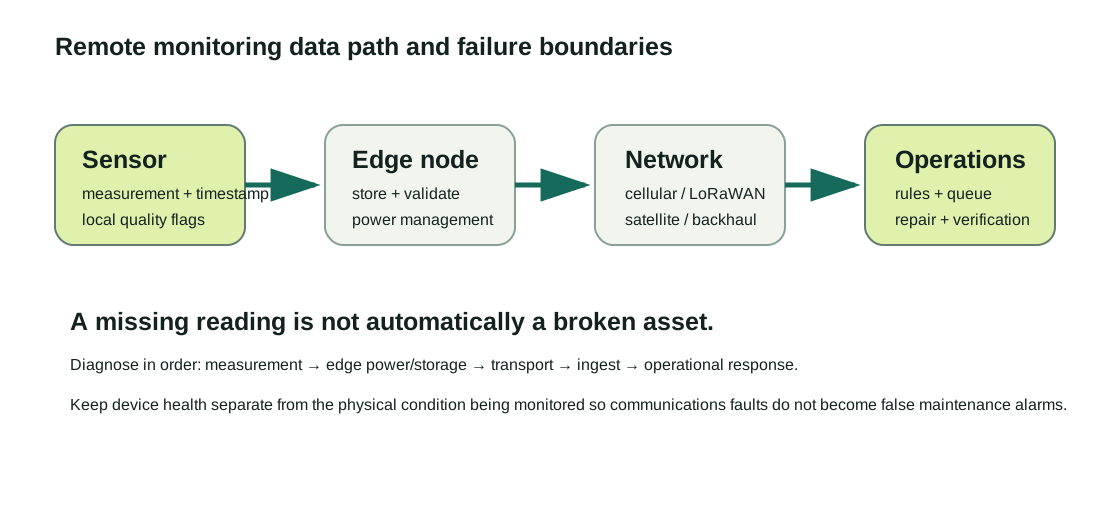
Separate sensor, power, network and asset failures
Remote monitoring collapses several failure domains into one screen. A flat line, a missing packet and a real infrastructure fault can look similar if the telemetry does not expose device health. For remote water monitoring, use the sequence below before assigning a repair crew. The purpose is not to delay urgent response; it is to prevent a communications or sensor fault from being mislabeled as an asset failure.
When a station appears failed, separate measurement, power, communications and asset state before dispatch. Ask whether the sensor is producing plausible local data, whether the logger is alive, whether the modem is attaching, and whether the physical asset shows a corroborating change such as zero flow or abnormal pressure.
| Observed pattern | Likely checks | Next action |
|---|---|---|
| No new data from one site | device voltage, reboot count, signal, local buffer, ingest log | Classify sensor/power/network/backend before asset dispatch. |
| Flat physical value with healthy telemetry | sensor range, fouling, frozen input, real steady state | Compare with secondary observation and recent maintenance. |
| Repeated short threshold crossings | noise, process cycling, sampling interval | Add persistence/hysteresis only after inspecting raw data. |
| Healthy data but no repair outcome | notification route, ownership, spare parts, ticket closure | Fix the response system rather than changing the sensor. |
Commission the full measurement-to-response path
A useful handover package includes one verified sensor reading, one successful uplink, one forced communications interruption with later data recovery, measured supply voltage, current configuration and the escalation contact role. The goal is to prove the complete path from field measurement to operator action.
For remote water monitoring, complete the following steps in order. If a step fails, correct it before treating later successful steps as proof of readiness. A cloud dashboard receiving one packet is not enough if the sensor reference, timestamp, power behavior or alert route is still unverified.
- Record the physical reference point, sensor serial/identity and firmware/configuration version.
- Compare the installed sensor against a trusted reference at at least two relevant states where practical.
- Force a communications interruption and confirm local buffering preserves original timestamps.
- Send a known test condition through the complete ingest and alert path.
- Confirm alert ownership, acknowledgement and escalation using a non-emergency test.
- Restore normal conditions and verify the ticket can be closed with defined evidence.
Test the system under weak-signal and outage conditions
Pilot acceptance should cover end-to-end behavior: measurement accuracy appropriate to the decision, timestamp continuity, offline buffering, delayed upload recovery, alarm delivery and closure after a field response. Include at least one weak-signal or power-cycle test; a perfect office connection says little about a remote installation.
Choose alert timing from the service consequence. A tank-level warning that allows a day of response can use longer persistence than a pump-failure alert for a high-demand site. Document the maximum acceptable detection delay, the confirmation signal and the point at which missing telemetry itself becomes an operational alarm.
- Measurement — Reference comparison falls inside the project tolerance and units/datum are correct.
- Time — Device and server timestamps remain within the project’s allowed error.
- Continuity — A planned link outage does not lose readings that should be locally retained.
- Alerting — The test condition reaches the intended role inside the action window.
- Recovery — Normal state and closure evidence are visible after the test.
- Security — Default credentials are absent and configuration/update authority is documented.
Worked example
Scenario. A handpump service wants a repair ticket within 60 minutes of a sustained non-use/fault pattern. The sensor samples every 5 minutes and normally reports every 15 minutes.
Calculation or rule. A 30-minute persistence rule needs six 5-minute samples. If the report interval stays at 15 minutes, the worst-case detection plus transmission delay must still leave enough time for routing inside the 60-minute action window.
Interpretation. Sampling faster than reporting can preserve diagnostic detail, while the alert path can send immediately when the persistence condition is satisfied. The example is intentionally transparent so the inputs can be replaced with local values rather than copied as a universal recommendation.
What remote deployments teach about operational response
Published rural handpump monitoring studies reviewed by Oxford report that automated operational data coupled to a repair service reduced average time-to-repair from weeks to a few days in Kenyan trials. UNICEF’s Smart Pumps work likewise treats sensing as a way to monitor use/functionality and support earlier failure recognition.
The causal design lesson is organizational: a sensor becomes valuable when a repair workflow, dispatch mechanism and closure check are already attached to the signal. Published deployment evidence is useful here as a design constraint, not as a promise that another programme will achieve the same result. Geography, spare-parts logistics, institutional incentives, staffing and connectivity all change outcomes.
Track configuration changes that alter interpretation
Do not freeze the configuration after launch. Review remote water monitoring after the first meaningful operating period, after any firmware/network change, and whenever false alarms, unexplained data gaps or missed failures appear. The review should compare the original decision requirement with actual response times and data quality, then change only one major rule at a time when possible so the effect can be observed.
Track configuration changes that alter interpretation: sampling/reporting interval, sensor range, calibration, modem profile, retry policy, power-saving mode and alarm logic. Annotating those changes beside the time series prevents a software or configuration change from being misread as a change in water service.
- Review false-positive and missed-alert examples monthly during early operation.
- Test buffer upload and alert routing after firmware or network changes.
- Track battery/solar margin across the least favorable seasonal conditions.
- Revalidate reference measurements after sensor replacement or physical work.
Sources and limits
Use these references to verify the underlying guidance. Local regulations, operator coverage and manufacturer instructions can change the correct implementation.
- WHO/UNICEF WASH systems monitoring framework (2026)WHO and UNICEF describe a common framework for monitoring the strength of systems that sustain WASH services.
- WHO/UNICEF GLAAS 2025 global updateThe report treats monitoring, review and use of data for decisions as one component of functioning WASH systems.
- UNICEF Smart PumpsUNICEF describes remote sensors and mobile technology used to monitor handpump use and functionality and to support earlier detection of failures.
- Oxford: Remote monitoring of rural water systems reviewThe review reports field studies where automated pump data combined with a repair service reduced average repair times dramatically, illustrating that sensing only creates value when linked to response.
- NISTIR 8259A IoT Device Cybersecurity Capability Core BaselineNIST identifies core capabilities such as device identification, controlled configuration, data protection, interface access control and secure software update.
Procurement questions for remote operating burden
Ask suppliers to describe the complete remote-operating burden: sensor replacement, local configuration, SIM or gateway ownership, battery/service interval, offline buffering, alarm routing, API/export access and what happens when the cloud service is unavailable. Price the field visits and dependencies, not only the device.
Verify the exact radio bands and certifications, enclosure/environmental rating, buffer capacity, time source, export/API format, remote-update behavior and recovery after power/network loss. Require the vendor to demonstrate these on the proposed hardware/firmware combination during the pilot.
- Can configuration, raw readings and quality flags be exported in a documented format without a proprietary dashboard?
- How are device identity, credentials, configuration authorization and software updates handled over the supported lifetime?
- What is the replacement/calibration process, and what happens to historical data when a device is swapped?
- Which network bands, roaming profiles or gateway requirements have been validated in the target countries?
- What evidence shows the claimed battery life under the intended reporting interval and weak-signal conditions?
- How are queued readings timestamped and de-duplicated after a communications outage?