Define coverage, latency and operating constraints first
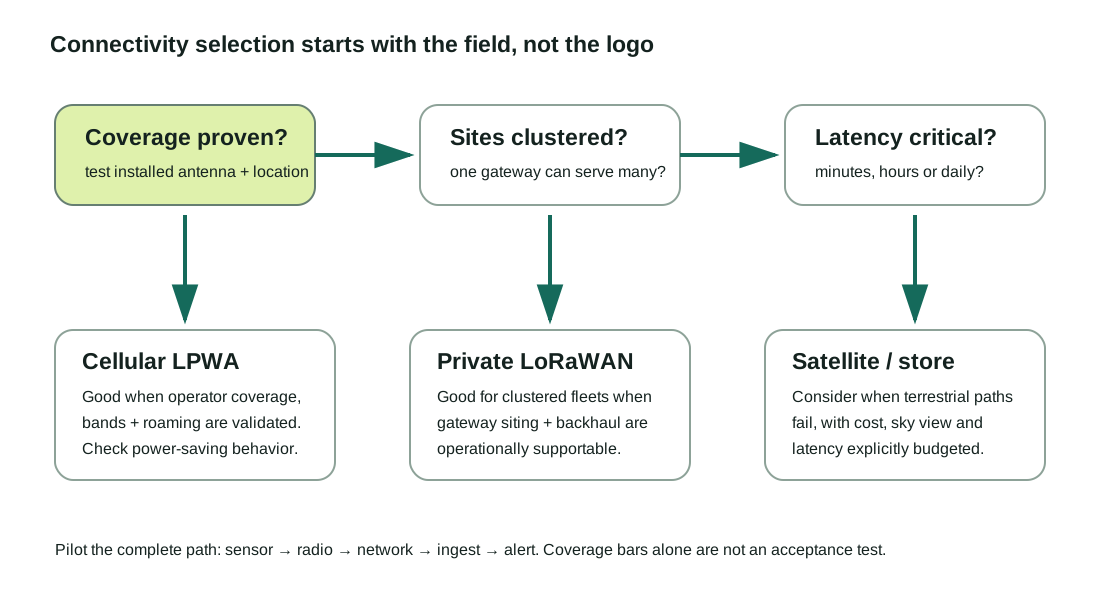
Connectivity choice is a field systems decision. Cellular LPWA can remove gateway ownership where suitable operator coverage exists; private LoRaWAN can be attractive when many sites can share a well-sited gateway and maintainable backhaul; satellite can reach places where terrestrial systems cannot but brings sky-view, energy, payload and cost constraints. The correct comparison uses the complete operational path and local evidence.
Start by writing the operational question in one sentence: What is the lowest-operational-burden path that meets the required latency at the actual installed site? Then define who will act, how quickly they must act, and what independent evidence will confirm that the action worked. A reading that cannot change a decision may still be useful for research, but it should not be confused with an operational alert. For remote sensor connectivity, the most common design error is to instrument the measurable variable before agreeing on the service decision it is meant to improve.
Match topology and service needs to connectivity options
Field-test installed geometry
Field-test installed geometry. Coverage maps are planning inputs, not acceptance evidence. Test the actual antenna, enclosure, height, band/profile and representative worst site. This makes the decision inspectable: another operator can see what condition triggered the choice, what evidence should be recorded, and what would cause the choice to be revisited.
Count gateway operations as part of LoRaWAN
Count gateway operations as part of LoRaWAN. A gateway concentrates radio coverage but creates its own power, backhaul and maintenance dependency. Model gateway visits and backhaul outage alongside sensor cost. This makes the decision inspectable: another operator can see what condition triggered the choice, what evidence should be recorded, and what would cause the choice to be revisited.
Treat latency as a requirement, not a default
Treat latency as a requirement, not a default. Many water trends tolerate hourly or daily reporting while fault response may need minutes. Write the action window and choose the least costly path that still meets it. This makes the decision inspectable: another operator can see what condition triggered the choice, what evidence should be recorded, and what would cause the choice to be revisited.
Design reconnect behavior
Design reconnect behavior. Weak networks can waste battery through aggressive retries. Test retry/backoff behavior and preserve data locally during outages. This makes the decision inspectable: another operator can see what condition triggered the choice, what evidence should be recorded, and what would cause the choice to be revisited.
Record field evidence for every candidate network path
A field design is only reproducible when the variables behind it are visible. The table below is a minimum record for remote sensor connectivity. Do not replace unknowns with optimistic defaults. Mark them unknown, collect the missing observation during the pilot, and record the date and method used to resolve them.
Capture field evidence for each candidate path: cellular RSRP/RSRQ or equivalent, gateway line-of-sight and distance for private radio, satellite sky view, expected payload size, reporting frequency, power budget and required latency. Coverage-map color alone is not enough to make a deployment decision.
| Variable | Record | Why it matters |
|---|---|---|
| Site distribution | clustered/dispersed | Changes value of shared gateways. |
| Installed signal | operator/gateway/satellite evidence | Tests the real path. |
| Max alert delay | minutes/hours/days | Constrains reporting and technology. |
| Payload/day | bytes or messages | Affects cost and energy. |
| Backhaul ownership | operator/private | Changes maintenance responsibility. |
| Power margin | battery/solar budget | Limits retry and transmit behavior. |
Diagnose the failed connectivity layer before switching technology
Remote monitoring collapses several failure domains into one screen. A flat line, a missing packet and a real infrastructure fault can look similar if the telemetry does not expose device health. For remote sensor connectivity, use the sequence below before assigning a repair crew. The purpose is not to delay urgent response; it is to prevent a communications or sensor fault from being mislabeled as an asset failure.
If connectivity is unreliable, distinguish radio coverage from backhaul, SIM/account, gateway, DNS/TLS or server problems. A LoRaWAN device may reach a gateway whose backhaul is down; a cellular modem may attach but fail data session; a satellite terminal may have blocked sky view. Diagnose the layer before changing technology.
| Observed pattern | Likely checks | Next action |
|---|---|---|
| Works outdoors, fails enclosed | antenna placement, enclosure attenuation, band | Retest installed geometry; move/engineer antenna. |
| Good signal but missed packets | network attach, retries, backend, congestion | Inspect modem/network/ingest logs, not RSSI alone. |
| LoRa sensors good, all sites go silent | gateway power/backhaul | Treat gateway as shared critical dependency. |
| Battery drain at marginal sites | repeated attach/retransmission | Measure radio states and adjust policy/profile. |
Commission radios in installed geometry
Commission the selected path in the installed enclosure and antenna position, not on a bench. Test at the weakest representative site, record signal/quality metrics, send repeated payloads, force a temporary outage and confirm reconnect plus buffered-data recovery.
For remote sensor connectivity, complete the following steps in order. If a step fails, correct it before treating later successful steps as proof of readiness. A cloud dashboard receiving one packet is not enough if the sensor reference, timestamp, power behavior or alert route is still unverified.
- Define max useful alert delay and normal reporting interval.
- Check current operator/technology availability and private-gateway constraints.
- Select representative strong, median and weak sites for pilot.
- Measure end-to-end delivery from installed geometry for at least a meaningful day/night operating window.
- Force a link outage and verify local buffering plus controlled reconnect.
- Record delivery ratio, latency distribution, energy behavior and maintenance dependencies.
Test the weakest representative site before fleet rollout
Acceptance should specify delivery success over a realistic observation window, maximum acceptable delay, reconnect behavior, energy impact and who maintains shared infrastructure such as gateways. Include at least one difficult site so fleet-level assumptions are not based on the easiest installation.
Select technology from topology and service requirements. Dense sites may justify gateway ownership; dispersed sites may favor public cellular where proven; isolated low-data assets may justify satellite despite higher cost. Keep a mixed architecture on the table when one technology is uneconomic for the hardest sites.
- Coverage evidence — Representative sites pass end-to-end payload delivery, not just signal detection.
- Latency — High-percentile delivery remains inside the action window.
- Recovery — Outage/reconnect does not lose buffered records.
- Energy — Measured radio behavior fits the maintenance interval with margin.
- Operations — Gateway/SIM/subscription/backhaul ownership is assigned.
- Portability — Data export and device configuration are documented.
Worked example
Scenario. Thirty sites lie within one watershed; 22 are within line-of-sight of a maintainable high point, while eight are isolated. Alerts can tolerate 30 minutes.
Calculation or rule. Pilot private LoRaWAN for the 22-site cluster and cellular LPWA at isolated sites where operator coverage is field-proven. Do not force one technology across all 30 sites if that adds gateways or weak links.
Interpretation. A mixed fleet can reduce operational burden when the device/data model remains consistent across transports. The example is intentionally transparent so the inputs can be replaced with local values rather than copied as a universal recommendation.
What field evidence changes the connectivity decision
GSMA’s 2026 Mobile IoT guidance highlights interoperability, deployment configuration, coverage and power-saving behavior for NB-IoT/LTE-M, while its current deployment map is useful for initial country screening. LoRa Alliance utility material documents the shared-gateway model used in metering deployments.
Standards availability narrows candidates, but field acceptance still depends on the local network, antenna installation and operating model. Published deployment evidence is useful here as a design constraint, not as a promise that another programme will achieve the same result. Geography, spare-parts logistics, institutional incentives, staffing and connectivity all change outcomes.
Track network, antenna and endpoint changes over time
Do not freeze the configuration after launch. Review remote sensor connectivity after the first meaningful operating period, after any firmware/network change, and whenever false alarms, unexplained data gaps or missed failures appear. The review should compare the original decision requirement with actual response times and data quality, then change only one major rule at a time when possible so the effect can be observed.
Track carrier/SIM changes, APN or radio-profile updates, gateway firmware/backhaul changes, antenna work, roaming policy and server endpoints. A connectivity trend can change because infrastructure or configuration changed even when the physical site did not.
- Repeat representative tests after carrier, antenna or firmware changes.
- Track gateway uptime separately from sensor uptime.
- Review data/SIM fees against actual payload volume.
- Keep a fallback path for high-consequence sites.
Sources and limits
Use these references to verify the underlying guidance. Local regulations, operator coverage and manufacturer instructions can change the correct implementation.
- GSMA Mobile IoT Deployment Guidelines (2026)GSMA highlights network configuration, interoperability, roaming, coverage and power-saving features such as PSM and eDRX for NB-IoT and LTE-M deployments.
- GSMA Mobile IoT Deployment Map (updated 2026)A current map for checking commercial NB-IoT and LTE-M availability by country before field design.
- LoRa Alliance: LoRaWAN for utilitiesLoRaWAN utility deployments illustrate the private-gateway model for low-power sensor fleets, including water metering use cases.
- 3GPP standards for IoT overview3GPP introduced NB-IoT and related cellular IoT features for low data-rate, extended-coverage and low-power applications; real deployment details still need operator-specific validation.
- NISTIR 8259A IoT Device Cybersecurity Capability Core BaselineNIST identifies core capabilities such as device identification, controlled configuration, data protection, interface access control and secure software update.