Classify the alert failure before tuning anything
Alert quality cannot be fixed by raising thresholds blindly. First label each bad outcome: false positive, missed event, duplicate, late alert, wrong fault class or premature closure. Then inspect the raw signal around the event and the expected operating state. This keeps nuisance suppression from becoming missed-failure risk.
Start by writing the operational question in one sentence: Is the error caused by the physical threshold, context/expected state, signal quality, persistence, transport or ticket logic? Then define who will act, how quickly they must act, and what independent evidence will confirm that the action worked. A reading that cannot change a decision may still be useful for research, but it should not be confused with an operational alert. For pump alert reliability, the most common design error is to instrument the measurable variable before agreeing on the service decision it is meant to improve.
Use corroborating signals to separate fault classes
Classify the alert error
Classify the alert error. Different errors have different causes. Tag false-positive, miss, late, duplicate, wrong-class and closure errors separately. This makes the decision inspectable: another operator can see what condition triggered the choice, what evidence should be recorded, and what would cause the choice to be revisited.
Inspect raw windows
Inspect raw windows. Aggregated dashboards can hide brief transitions and quality flags. Review raw values before and after the event with timestamps/device health. This makes the decision inspectable: another operator can see what condition triggered the choice, what evidence should be recorded, and what would cause the choice to be revisited.
Add persistence only to noise
Add persistence only to noise. Persistence reduces transient alarms but also delays detection. Measure acceptable delay and test known real events before increasing it. This makes the decision inspectable: another operator can see what condition triggered the choice, what evidence should be recorded, and what would cause the choice to be revisited.
Separate telemetry loss
Separate telemetry loss. No data is not equivalent to pump failure. Create a device/link-health alert with its own diagnostic path. This makes the decision inspectable: another operator can see what condition triggered the choice, what evidence should be recorded, and what would cause the choice to be revisited.
Capture the evidence around every false or missed alert
A field design is only reproducible when the variables behind it are visible. The table below is a minimum record for pump alert reliability. Do not replace unknowns with optimistic defaults. Mark them unknown, collect the missing observation during the pilot, and record the date and method used to resolve them.
Capture the exact evidence around each bad alert: commanded pump state, current signature, flow, pressure, tank or source level, telemetry freshness and recent maintenance. Classifying false positives by pattern is more useful than simply counting them because each pattern points to a different corrective action.
| Variable | Record | Why it matters |
|---|---|---|
| Expected state | on/off/demand | Prevents alerting on legitimate inactivity. |
| Raw signal | current/flow/pressure/vibration | Shows the physical evidence. |
| Persistence | count/time | Controls transient response. |
| Hysteresis | enter/exit thresholds | Prevents chattering near boundary. |
| Telemetry health | last seen/voltage/link | Separates monitoring failure. |
| Closure rule | restoration evidence | Avoids false recovery. |
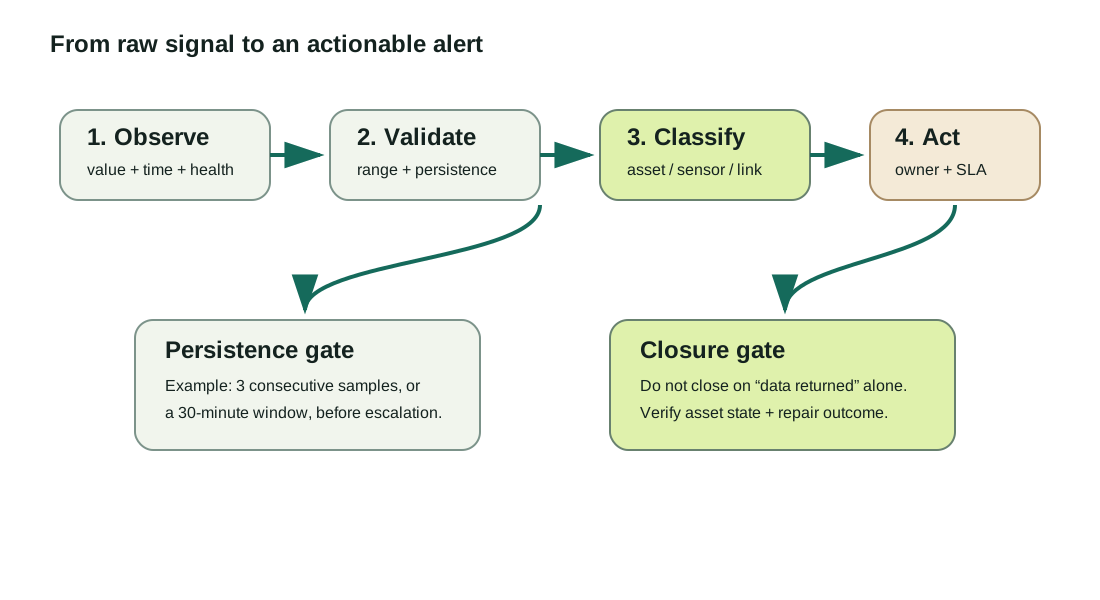
Verify the pump state before changing thresholds
Remote monitoring collapses several failure domains into one screen. A flat line, a missing packet and a real infrastructure fault can look similar if the telemetry does not expose device health. For pump alert reliability, use the sequence below before assigning a repair crew. The purpose is not to delay urgent response; it is to prevent a communications or sensor fault from being mislabeled as an asset failure.
For a suspected false alarm, verify whether the pump actually changed state before adjusting thresholds. Current clamp movement, missing flow data, pressure-sensor faults or stale telemetry can make a healthy pump look failed. For a missed failure, inspect whether the rule required a signal that itself disappeared during the event.
| Observed pattern | Likely checks | Next action |
|---|---|---|
| Frequent one-sample alarms | noise/transients | Use raw distribution and persistence/hysteresis. |
| Missed slow degradation | threshold too absolute | Consider rate/trend plus absolute safety limits. |
| Alarm when pump scheduled off | missing expected-state context | Join schedule/control/demand state. |
| Alarm clears when data returns | closure tied to telemetry not service | Require service-restoration evidence. |
Recommission rules with labelled pump states
Recommission the alert logic with labelled examples: normal start, normal stop, short transient, sustained run, no-flow condition where safely reproducible, and communications loss. Save the traces so future tuning can be compared against the same known states instead of ad-hoc field impressions.
For pump alert reliability, complete the following steps in order. If a step fails, correct it before treating later successful steps as proof of readiness. A cloud dashboard receiving one packet is not enough if the sensor reference, timestamp, power behavior or alert route is still unverified.
- Export disputed alert windows with raw values and quality/device-health fields.
- Label the operational truth for each event using independent evidence.
- Identify which rule stage created the error: context, threshold, persistence, transport or closure.
- Change one rule and replay/back-test against both nuisance and real events.
- Run a controlled non-emergency test at a representative site.
- Track error rates after change and retain the previous configuration for comparison.
Prove the revised rules over representative pump cycles
Set an acceptance window with a defined number of representative cycles and at least one controlled alert test. Track false dispatches separately from harmless warning notifications, and require every severe alert to show the evidence that distinguishes pump failure from sensor or communications failure.
Tune persistence and corroboration before widening thresholds indefinitely. If motor current is noisy, a second hydraulic signal or expected-state model may improve specificity. Any new rule should be checked against past known events so a false-positive fix does not create a new missed-failure problem.
- Traceability — Every alert stores the rule/version and evidence window.
- False positives — Target is defined as a rate per site/time, not vague “fewer alerts”.
- Missed events — Known test event still triggers inside allowed delay.
- Telemetry — Link/device loss has a separate alert class.
- Closure — Recovery requires defined physical/service evidence.
- Rollback — Previous rule set can be restored if performance worsens.
Worked example
Scenario. A current sensor crosses 3.0 A for one sample during motor start, generating a fault, while real overloads persist for several minutes.
Calculation or rule. A three-consecutive-sample rule at 30-second sampling delays classification by roughly 60–90 seconds depending on implementation, while rejecting a single transient. Verify that this delay is acceptable for the fault risk.
Interpretation. Persistence is justified by observed signal behavior and risk, not by a generic “three samples” convention. The example is intentionally transparent so the inputs can be replaced with local values rather than copied as a universal recommendation.
Track maintenance changes that shift alert behavior
Do not freeze the configuration after launch. Review pump alert reliability after the first meaningful operating period, after any firmware/network change, and whenever false alarms, unexplained data gaps or missed failures appear. The review should compare the original decision requirement with actual response times and data quality, then change only one major rule at a time when possible so the effect can be observed.
Keep a dated record of current-clamp service, motor/controller changes, hydraulic sensor maintenance and alert-rule edits. When alert quality changes, this history helps determine whether the cause was the asset, the sensing chain or the logic.
- Review a sample of alerts against ground truth each month.
- Version every threshold/persistence change.
- Track misses as carefully as false positives.
- Recheck after pump/controller maintenance changes normal signatures.
Sources and limits
Use these references to verify the underlying guidance. Local regulations, operator coverage and manufacturer instructions can change the correct implementation.
- Oxford: Remote monitoring of rural water systems reviewThe review reports field studies where automated pump data combined with a repair service reduced average repair times dramatically, illustrating that sensing only creates value when linked to response.
- FAO sourcebook: solar energy in irrigated agriculture (2022)FAO covers design, operation, inspection, troubleshooting and maintenance of solar photovoltaic pumping systems.
- NISTIR 8259A IoT Device Cybersecurity Capability Core BaselineNIST identifies core capabilities such as device identification, controlled configuration, data protection, interface access control and secure software update.