Define the groundwater decision before choosing sensors
A water-level time series is not self-explanatory. Pumping, recharge, barometric effects, nearby abstraction, sensor drift, well construction and the chosen reference point can all change the record. USGS guidance emphasizes that measurement frequency follows monitoring objectives. Begin with the temporal process that matters—seasonal recharge, drought response, pumping drawdown or long-term trend—then choose observation wells and frequency that can resolve it.
Start by writing the operational question in one sentence: What temporal and spatial change must the network detect, and what decision will that change trigger? Then define who will act, how quickly they must act, and what independent evidence will confirm that the action worked. A reading that cannot change a decision may still be useful for research, but it should not be confused with an operational alert. For groundwater-level monitoring, the most common design error is to instrument the measurable variable before agreeing on the service decision it is meant to improve.
Turn the management question into measurement rules
Tie frequency to the process
Tie frequency to the process. Monthly manual readings can describe a slow seasonal pattern but may miss short pumping cycles; high-frequency logging can reveal rapid stress but creates more QA work. State the shortest variation that must be resolved and sample materially faster than that variation. This makes the decision inspectable: another operator can see what condition triggered the choice, what evidence should be recorded, and what would cause the choice to be revisited.
Use a permanent measurement datum
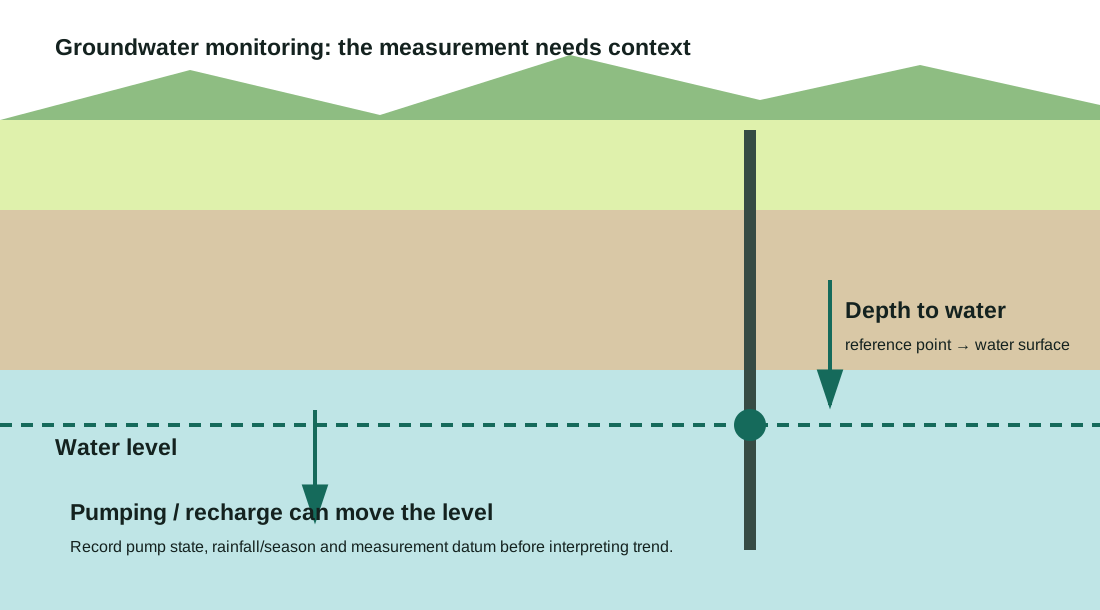
Use a permanent measurement datum. Changing the tape/sensor reference point can create an artificial step in the time series. Mark and document the reference point and retain any offset when equipment is changed. This makes the decision inspectable: another operator can see what condition triggered the choice, what evidence should be recorded, and what would cause the choice to be revisited.
Record pumping context
Record pumping context. A falling level during pumping is not automatically regional aquifer decline. Capture pump state, nearby abstraction where available, and time since pumping for interpretation. This makes the decision inspectable: another operator can see what condition triggered the choice, what evidence should be recorded, and what would cause the choice to be revisited.
Validate automatic loggers with independent readings
Validate automatic loggers with independent readings. Drift or venting/pressure errors can persist quietly. Schedule manual reference checks and record corrections without overwriting raw observations. This makes the decision inspectable: another operator can see what condition triggered the choice, what evidence should be recorded, and what would cause the choice to be revisited.
Record datum, pumping and compensation context
A field design is only reproducible when the variables behind it are visible. The table below is a minimum record for groundwater-level monitoring. Do not replace unknowns with optimistic defaults. Mark them unknown, collect the missing observation during the pilot, and record the date and method used to resolve them.
For each well, record water-level units, the physical measuring point, sensor depth, logger interval, barometric-compensation method and whether a reading was taken while the pump was running. Keep the manual reference measurement beside the automated value so a later reviewer can distinguish aquifer change from datum or transducer change.
| Variable | Record | Why it matters |
|---|---|---|
| Well construction | depth, screen/open interval, aquifer | Defines what water body the reading represents. |
| Reference point | elevation/offset and mark | Preserves comparability. |
| Measurement frequency | 15 min / hourly / monthly etc. | Must resolve the management process. |
| Pump state | on/off and recent operation | Separates drawdown/recovery from background. |
| Rainfall/recharge context | event/season indicator | Supports interpretation of climate response. |
| Sensor correction | raw value + correction history | Prevents silent rewriting of observations. |
Separate aquifer change from measurement faults
Remote monitoring collapses several failure domains into one screen. A flat line, a missing packet and a real infrastructure fault can look similar if the telemetry does not expose device health. For groundwater-level monitoring, use the sequence below before assigning a repair crew. The purpose is not to delay urgent response; it is to prevent a communications or sensor fault from being mislabeled as an asset failure.
A sudden groundwater-level jump should first be separated into aquifer, pumping and instrumentation possibilities. Check nearby pumping status, battery and logger health, barometric input where used, and the most recent manual depth-to-water reading before treating the change as a real hydrogeologic event.
| Observed pattern | Likely checks | Next action |
|---|---|---|
| Sudden permanent step | datum moved, sensor serviced, well work, real shift | Check maintenance/configuration record before hydrologic interpretation. |
| Daily saw-tooth pattern | nearby pumping/recovery | Compare pump schedules and time-of-day. |
| Slow divergence from manual checks | sensor drift/pressure compensation | Calibrate/replace and retain correction metadata. |
| Many wells fall together | regional recharge/drought or shared systematic issue | Check independent climate/context data and reference procedure. |
Commission the well from reference point to dashboard
At handover, capture the well identifier, measuring-point description, transducer serial/range, installed depth, initial manual water level, logger time, telemetry test and one downloaded raw record. Those items let another technician reconstruct the measurement chain without guessing which reference or offset was used.
For groundwater-level monitoring, complete the following steps in order. If a step fails, correct it before treating later successful steps as proof of readiness. A cloud dashboard receiving one packet is not enough if the sensor reference, timestamp, power behavior or alert route is still unverified.
- Document well construction, the monitored hydrogeologic unit and site objective.
- Establish and mark the measurement reference point; record its relation to land-surface datum/elevation as appropriate.
- Take an independent manual/reference water-level reading before installing the logger.
- Run the logger alongside a second reference check and verify units/time/pressure compensation.
- Record pumping state and relevant site conditions during acceptance observations.
- Schedule future manual checks and define how drift corrections will be recorded.
Set groundwater acceptance tests before handover
A groundwater pilot should prove more than successful uploads. Define acceptable agreement with manual checks, allowable missing-record rate, clock accuracy, recovery after a communications outage and the process for flagging readings taken during pumping. Test through enough pump cycles to expose drawdown and recovery behavior.
Set drift and discrepancy limits from the decision the data supports. A network used for seasonal trend detection may tolerate a different verification interval than one used to trigger pumping restrictions. Record the chosen tolerance and require a manual check whenever the automated series exceeds it without a plausible pumping or rainfall explanation.
- Datum — Reference point is physically and digitally documented.
- Agreement — Logger and reference reading agree within the programme’s stated tolerance.
- Frequency — Sampling interval resolves the shortest process named in the objective.
- Context — Pump state and relevant environmental context can be joined to the time series.
- Continuity — Data gaps and sensor service events are visible rather than interpolated silently.
- Traceability — Raw observations remain recoverable after QA corrections.
Worked example
Scenario. A programme needs to distinguish seasonal groundwater decline from short pumping drawdown. A well shows 0.7 m drops during several hours of daily pumping.
Calculation or rule. A monthly reading taken during a pumping event could be biased relative to a reading taken after recovery. High-frequency logging over a pilot period reveals the drawdown/recovery cycle; the programme can then specify a consistent manual timing or retain continuous logging.
Interpretation. The right frequency is the one that resolves the confounding process, not simply the highest available rate. The example is intentionally transparent so the inputs can be replaced with local values rather than copied as a universal recommendation.
What field evidence shows about groundwater telemetry
USGS guidance explicitly makes frequency dependent on the monitoring objective and need to discriminate short- and long-term stresses. The USGS Climate Response Network also demonstrates how site selection and measurement cadence are deliberately controlled to observe climate variability rather than local pumping effects.
A logger cannot compensate for a poorly defined observation well or datum. Network design and measurement context are part of data quality. Published deployment evidence is useful here as a design constraint, not as a promise that another programme will achieve the same result. Geography, spare-parts logistics, institutional incentives, staffing and connectivity all change outcomes.
Review drift, datum and configuration changes
Do not freeze the configuration after launch. Review groundwater-level monitoring after the first meaningful operating period, after any firmware/network change, and whenever false alarms, unexplained data gaps or missed failures appear. The review should compare the original decision requirement with actual response times and data quality, then change only one major rule at a time when possible so the effect can be observed.
Log changes that can move the groundwater series: transducer replacement, cable repositioning, measuring-point alteration, barometric source changes, pumping regime changes and any applied offset. When one occurs, annotate the time series at the exact timestamp so a step change is not mistaken for a water-level trend.
- Compare automatic and reference readings on a defined schedule.
- Inspect datum/reference marks after well or enclosure work.
- Flag pumping, sensor service and known disturbances in the record.
- Review whether sampling frequency still matches the decision as objectives evolve.
Sources and limits
Use these references to verify the underlying guidance. Local regulations, operator coverage and manufacturer instructions can change the correct implementation.
- USGS: Ground-Water-Level Measurements — Why Frequency MattersUSGS says measurement frequency should be chosen from the monitoring objective and be sufficient to separate short-term and long-term hydrologic effects.
- USGS Climate Response NetworkUSGS describes groundwater observations ranging from periodic manual readings to continuous 15–60 minute sensing, with site-selection controls for climate response.
- NASA GRACE/GRACE-FO drought monitoringNASA describes GRACE-derived groundwater and soil-moisture indicators for broad drought context; these are regional indicators, not substitutes for a local well measurement.
- FAO irrigation and agricultural water managementFAO notes the water-management implications of irrigation technology, including the need to manage abstraction rather than treating energy availability as the only constraint.
- WHO/UNICEF WASH systems monitoring framework (2026)WHO and UNICEF describe a common framework for monitoring the strength of systems that sustain WASH services.
Procurement questions for long-term groundwater records
For groundwater systems, ask how the supplier establishes the measuring datum, handles vented or absolute pressure compensation, records sensor depth, supports manual verification and preserves raw level data after calibration or offset changes. Replacement procedures should not require losing the continuity of the well record.
Verify the exact transducer range/accuracy, cable construction, venting or barometric method, logger resolution, time synchronization, export format and field-replaceable parts for the configuration you will buy. Confirm how a replacement sensor is reconciled with the previous series before accepting a long-term monitoring platform.
- Can configuration, raw readings and quality flags be exported in a documented format without a proprietary dashboard?
- How are device identity, credentials, configuration authorization and software updates handled over the supported lifetime?
- What is the replacement/calibration process, and what happens to historical data when a device is swapped?
- Which network bands, roaming profiles or gateway requirements have been validated in the target countries?
- What evidence shows the claimed battery life under the intended reporting interval and weak-signal conditions?
- How are queued readings timestamped and de-duplicated after a communications outage?